Investment Casting Process: Steps, Pros, Cons and Materials
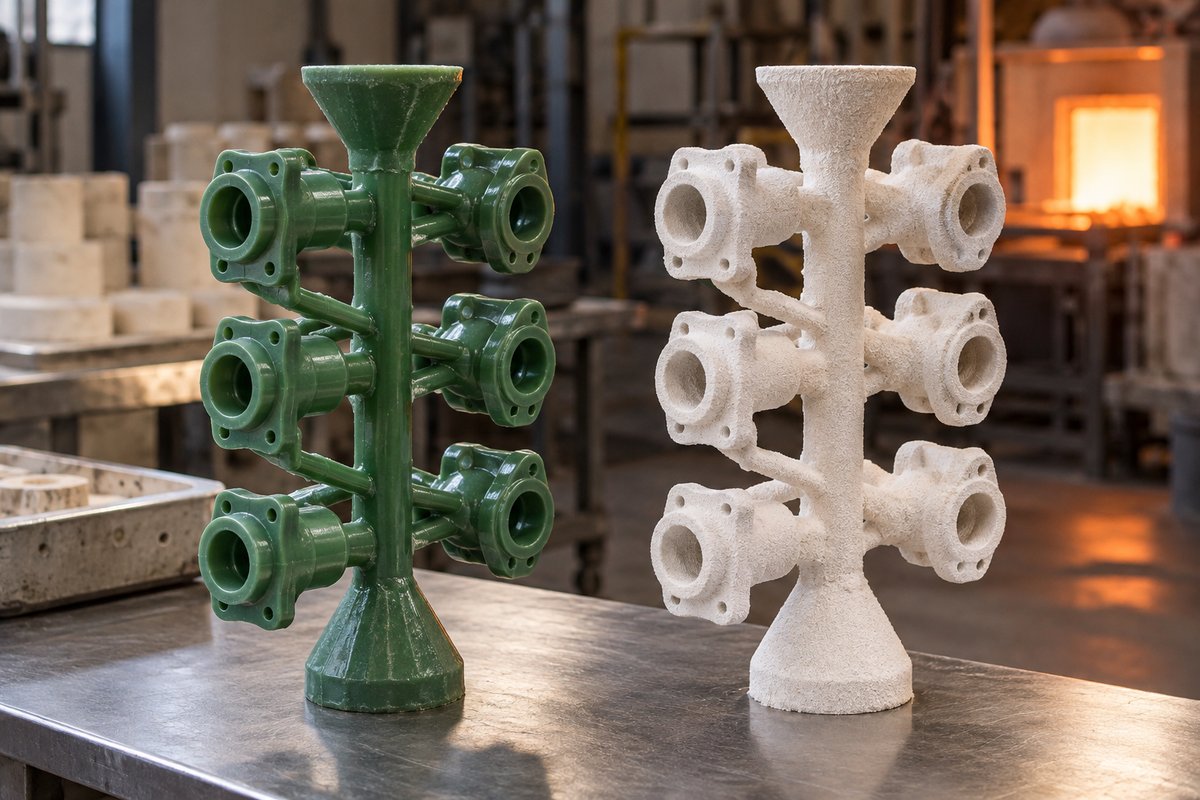
Investment casting (lost-wax casting) makes a wax replica of the part, coats it in ceramic, melts the wax out and pours metal into the cavity. Each wax pattern is destroyed in the process, which is why it is called lost-wax.
The investment casting process, step by step
- Wax pattern — wax is injected into a pattern die to make an exact replica of the part.
- Tree assembly — patterns are attached to a wax sprue to form a tree.
- Shell building — the tree is dipped in ceramic slurry and coated with stucco, repeated until the shell is thick enough.
- Dewax and firing — the wax is melted out and the shell is fired to strengthen it.
- Pouring — molten metal is poured into the hot shell.
- Knock-out and finishing — the shell is broken away, parts are cut from the tree, then ground, heat treated and machined as required.
Advantages
- Complex geometry — internal features and undercuts in one piece
- Wide material range — stainless, carbon and alloy steels, and more
- Good surface and accuracy — far smoother than sand casting
- Part consolidation — can replace welded or bolted assemblies
Limitations
- More steps per part — slower and more costly per piece than die casting at volume
- Size limits — very large parts are better suited to sand casting
- Precision features — fits and tight bores are normally machined
Common materials
| Group | Examples |
|---|---|
| Stainless steel | CF8 (304), CF8M (316), CF3M, 17-4PH (CB7Cu-1) |
| Carbon and low-alloy steel | WCB, 1020–1045, 4140, 8620 equivalents |
| Others | Some aluminum and copper alloys, heat-resistant alloys |
Investment casting vs die casting
| Investment casting | Die casting | |
|---|---|---|
| Materials | Steel and stainless | Aluminum and zinc |
| Tooling | Lower | Higher |
| Cycle | Long per part | Short |
| Quantity | Low to medium | Medium to high |
FAQ
Is investment casting the same as lost-wax casting?
Yes. "Investment casting" is the common industrial term; "lost-wax" describes how the wax pattern is melted out.
Is cast 316 (CF8M) the same as 316 bar?
The chemistry is similar, but cast grades and wrought grades are defined by different standards. Specify the grade and standard your design requires.