Zinc Die Casting
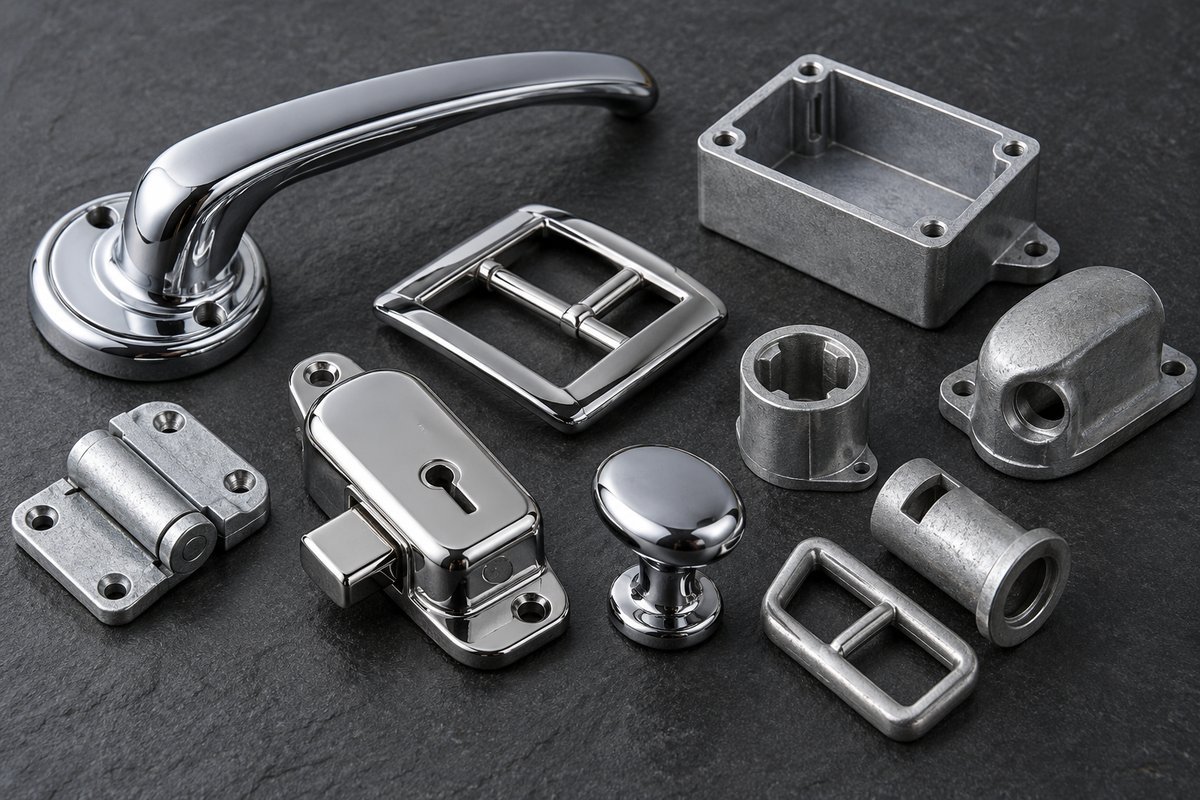
Zinc die casting uses zinc alloys — most often Zamak 3 and Zamak 5 — on fast hot-chamber machines. The low melting point and excellent fluidity make zinc ideal for small, thin-walled parts with fine detail, and it takes decorative plating well. Typical parts include handles, locks, buckles, small housings and decorative hardware.
Why choose zinc
| Advantage | Detail |
|---|---|
| Fine detail | Thin walls, small holes, lettering and textures can be cast in |
| Plating | Well suited to chrome, nickel and other decorative plating |
| Die life | Lower casting temperature usually gives longer die life than aluminum |
| Speed | Hot-chamber machines run fast cycles |
| Watch-outs | About 2.5× the density of aluminum, so parts are heavier; creep at elevated temperature must be considered |
Zamak alloys
| Alloy | ASTM | Japanese equivalent | Notes |
|---|---|---|---|
| Zamak 3 | AG40A | ZDC2 | The standard alloy; good dimensional stability and plating quality |
| Zamak 5 | AC41A | ZDC1 | Contains copper; higher strength and hardness than Zamak 3 |
Typical properties (reference values): Zamak 3 about 283 MPa tensile strength and 10% elongation; Zamak 5 about 328 MPa and 7%. Higher-strength ZA alloys are also used for some applications.
Finishing zinc die castings
Zinc castings are usually plated (chrome, nickel, zinc), painted or conversion coated. Plating quality depends heavily on the as-cast surface and polishing, so cosmetic standards and limit samples are agreed before production.
Zinc or aluminum?
- Small, detailed, plated parts → zinc die casting
- Weight-sensitive or larger housings → aluminum die casting
- Steel or stainless required → investment casting
FAQ
Is zinc die casting cheaper than aluminum?
It depends on size and weight. Zinc's density raises material cost on large parts, but on small parts the faster cycle and reduced machining can make it competitive. Compare like-for-like quotes.
Can you provide RoHS documentation?
Tell us which documents you need (composition, RoHS test reports, plating composition) at the quotation stage and we will confirm what can be supplied.